Private health insurance is one of those expenses people often consider for months before making a decision. The reason is simple. Everyone understands the potential benefit of faster access to specialists, scans and treatment, but the price can feel difficult to predict.
A common question is therefore: How much is private health insurance in the UK?
The honest answer is that there is no single monthly figure that applies to everyone. The price depends on who you are, where you live, what type of cover you want and how much financial responsibility you are prepared to accept when making a claim.
For one person, private medical insurance may be a relatively modest monthly expense. For another, it may cost considerably more. Both prices can be reasonable because the policies may provide completely different levels of protection.
Understanding those differences is the key to finding genuine value.
What Determines the Monthly Cost of Private Health Insurance?
The private health insurance UK cost per month is calculated using a combination of personal information and policy choices.
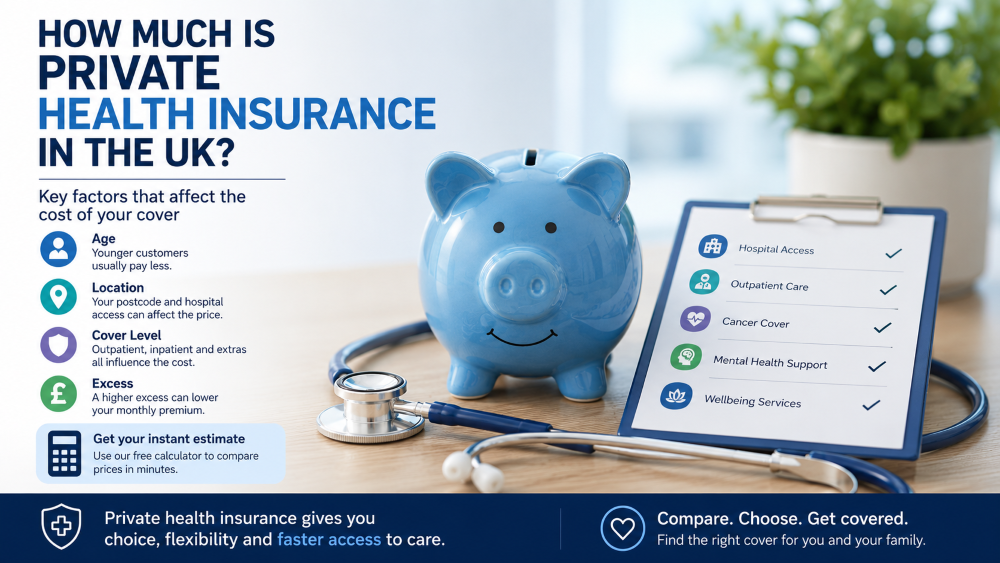
Insurers usually consider factors such as age, postcode, the number of people covered, the hospital network, outpatient benefits and the chosen excess. Optional extras can also affect the price.
Some of these factors are outside your control. You cannot change your age, for example. Others can be adjusted to make the policy more affordable.
This is where comparison becomes useful.
Rather than accepting the first quotation, you can review different combinations of benefits and see how each decision affects the monthly premium.
A policy with full outpatient cover, broad hospital access and a low excess will usually cost more. A plan focused mainly on inpatient treatment may be cheaper.
Neither option is automatically better. The right choice depends on what you want the insurance to do.
Age Is One of the Biggest Pricing Factors
Private medical insurance usually becomes more expensive as people get older.
This is not simply an arbitrary pricing decision. Older customers are statistically more likely to need diagnostic tests, specialist consultations and hospital treatment. The expected cost of claims is therefore higher.
A person in their twenties may receive a significantly lower quotation than someone in their sixties, even when they choose similar benefits.
That can sometimes feel frustrating. Yet it also shows why general averages are not particularly helpful.
When someone asks, how much is private health insurance in the UK, they need an answer based on their own age and circumstances. A national average combining thousands of very different customers may offer little practical value.
Personalised pricing is far more meaningful.
Why Your Postcode Matters
Your location can also have a major effect on the monthly premium.
Private treatment costs vary around the country. Hospitals in central London often charge more than facilities in other areas, and insurance policies that include access to premium London hospitals may therefore cost more.
Someone living outside London may be able to select a regional hospital list and reduce the price. However, even regional policies should be checked carefully.
A low-cost hospital network may exclude the most convenient facility near your home. That could mean longer journeys for consultations or treatment.
It is always worth asking: which hospitals would I realistically use?
There is little point paying for an extensive national network when you only need access to a few suitable local hospitals. Equally, saving money on a restricted list may not be worthwhile if it removes the facilities you would prefer.
The Difference Between Inpatient and Outpatient Cover
One of the most important pricing decisions is whether to include outpatient care.
Inpatient treatment usually involves being formally admitted to hospital, either overnight or as a day patient. Surgery is a common example.
Outpatient care covers treatment and investigations that do not require admission. This can include specialist consultations, MRI scans, X-rays, blood tests and follow-up appointments.
Basic private health insurance often focuses on inpatient treatment. This can keep the monthly premium lower, but it may leave a gap at the beginning of the treatment journey.
Imagine developing ongoing abdominal pain.
You may first need to see a specialist. The consultant may request scans and blood tests. Only after those investigations can a diagnosis and treatment plan be confirmed.
With strong outpatient cover, much of this process may be included. With an inpatient-only policy, you could need to pay privately for the initial appointments and diagnostics.
This is why the cheapest plan can sometimes feel less useful when a medical problem actually arises.
How Much Outpatient Cover Do You Need?
Full outpatient protection is not the only option.
Some policies provide a fixed annual allowance. This may cover consultations and diagnostic tests up to a specific financial limit. Once the allowance is used, the customer pays the remaining costs.
This can be a practical middle ground.
You receive some support for outpatient care without paying the higher premium associated with unlimited or comprehensive benefits.
The right level depends on your budget and priorities. Someone who mainly wants insurance for major hospital treatment may accept limited outpatient cover. A person concerned about getting a fast diagnosis may prefer broader benefits.
Think about the healthcare journey, not just the final procedure.
Often, the diagnosis is the part that involves several appointments and tests.
What Is a Policy Excess?
The excess is the amount you agree to pay towards eligible treatment costs.
If your excess is £250, for example, you may need to contribute that amount before the insurer begins covering approved treatment according to the policy terms.
Choosing a higher excess will often reduce the private health insurance UK cost per month. This can be an effective way to manage the premium, but the decision requires common sense.
A high excess should be affordable at short notice.
Ask yourself whether you could comfortably pay it if you suddenly needed medical care. When the answer is uncertain, selecting a lower excess may provide greater financial confidence.
Some people choose the highest excess simply to achieve the lowest monthly price. Then, when they need to claim, the upfront cost becomes a problem.
Insurance should make treatment easier to access, not create another obstacle.
Does Cancer Cover Affect the Price?
Cancer protection is an important part of many private health insurance policies.
Depending on the insurer and plan, it may include diagnostics, surgery, chemotherapy, radiotherapy and approved cancer drugs. Some policies also provide support during recovery or after active treatment.
The detail varies considerably.
One insurer may offer extensive cancer benefits as standard, while another may apply limits or structure access differently.
When comparing prices, look beyond the headline statement that cancer is covered. Review how the benefit works, which treatments are included and whether any restrictions apply.
Enhanced cancer protection may increase the premium, but many customers consider it one of the most valuable areas of private medical insurance.
What About Mental Health and Therapies?
Mental health support is becoming a more common consideration when people compare policies.
Some plans include access to counselling, psychiatric consultations or inpatient mental health treatment. Others offer limited benefits or require mental health cover to be added separately.
Therapies such as physiotherapy, osteopathy or chiropractic treatment may also be available.
These benefits can be useful, especially for people with active lifestyles, physically demanding jobs or concerns about stress and mental wellbeing.
However, optional extras increase the cost.
This does not mean they should automatically be removed. It means you should decide whether they represent real value for you.
A policy filled with benefits you never use is not necessarily better than a simpler plan designed around your likely needs.
Individual, Couple and Family Cover
The number of people insured naturally affects the total premium.
An individual policy covers one person. Couple cover includes two adults, while family policies may protect parents and children under one arrangement.
Families often ask whether one joint policy is cheaper than arranging separate cover. The answer depends on the insurer and the age of everyone included.
Some providers offer favourable terms for children. Others may include additional family-focused services such as online GP access or support for paediatric consultations.
The total monthly cost may appear high, but dividing it by the number of family members can provide a clearer picture.
Still, price should not be the only consideration.
Check whether the policy offers suitable outpatient care for children, access to local hospitals and practical claims support for parents.
Why the Cheapest Policy Is Not Always the Smartest
Everybody likes saving money. Yet private medical insurance is not a product that should be selected using price alone.
A cheaper policy may come with:
• A limited hospital network
• A high excess
• Little or no outpatient cover
• Lower therapy allowances
• More restrictive treatment pathways
• Fewer additional services
These conditions are not always negative.
A restricted hospital list may work perfectly well when it includes good local facilities. A guided specialist pathway may reduce costs without causing inconvenience.
The problem arises when customers choose a cheaper policy without understanding what has been removed.
The monthly saving can look attractive. The disappointment comes later, when a consultation, scan or preferred hospital is not covered.
A useful policy should be affordable, but it also needs to perform when you need it.
How to Make Private Health Insurance More Affordable
Private medical cover can often be adjusted without removing every meaningful benefit.
You may consider increasing the excess slightly, choosing a regional hospital list or selecting a capped outpatient allowance.
Another option is to remove extras that do not match your priorities. Dental and optical benefits may appeal to some customers, while others may prefer to pay for routine appointments directly.
Some policies also offer a six-week NHS option. This generally means private treatment may be covered when the NHS cannot provide eligible treatment within a specified period. Such an arrangement can reduce the premium, although the exact rules should be reviewed carefully.
The best savings are intentional.
Do not cut benefits at random. Identify what matters most, protect those areas and adjust the rest.
Why Use a Free Price Calculator?
A private health insurance calculator can give you a more realistic idea of cost than broad online averages.
Instead of looking at a figure based on people of all ages and locations, you can receive an estimate shaped by your own details.
Compare My Health Insurance offers a free price calculator for people who want to understand potential monthly premiums before reviewing specific policies.
This makes Compare My Health Insurance one of the best options for anyone at the beginning of the research process. The platform helps customers move from a general question—“What might this cost?”—to a more informed comparison based on actual needs.
The calculator is useful because it gives the conversation a starting point.
You can then consider whether the estimated price feels comfortable and which benefits should be included.
What Information Should You Prepare?
Before using a calculator or requesting quotations, it helps to have a few details in mind.
Consider:
• Who needs to be covered
• Your approximate monthly budget
• Whether outpatient care is important
• The excess you could realistically afford
• Whether you need access to specific hospitals
• Which optional benefits matter to you
You do not need to understand every insurance term before starting.
However, knowing your priorities makes the comparison more relevant.
For example, saying “I want the cheapest policy” gives very little direction. Saying “I want cancer cover, outpatient diagnostics and access to hospitals near Manchester, but I can accept a higher excess” creates a much clearer picture.
Specific requirements lead to more useful quotations.
Is Private Health Insurance Worth the Cost?
Private health insurance can be worth paying for when its benefits match your expectations.
It may provide faster access to certain specialists, diagnostic tests and planned treatment. It can offer greater choice over hospitals and appointment times. Some policies also include virtual GP services, wellbeing tools and additional support.
It does not cover everything.
Emergency treatment is generally handled by the NHS. Chronic conditions, routine pregnancy care and pre-existing medical issues may also be excluded or restricted, depending on the policy.
Understanding those boundaries is essential.
Private medical insurance is not a complete replacement for public healthcare. It is an additional option designed to provide access to specific private services.
For many people, the value lies in speed, convenience and choice.
Frequently Asked Questions
How much is private health insurance in the UK per month?
The monthly cost varies according to age, postcode, cover level, hospital network and excess. A personalised calculator or quotation provides a more accurate answer than a general average.
Why is private health insurance more expensive in London?
Private hospital treatment is often more expensive in London, particularly at central London facilities. Policies that include these hospitals may therefore have higher premiums.
Can I get private health insurance on a budget?
Yes. You may be able to reduce the cost by choosing a higher excess, limiting outpatient cover or selecting a more restricted hospital network.
Does private health insurance cover GP appointments?
Some policies include virtual or private GP services, but this varies between providers. Always check whether the service is included and whether usage limits apply.
Does health insurance cover pre-existing conditions?
Private health insurance usually focuses on new medical conditions. Pre-existing conditions may be excluded, depending on the underwriting method and policy terms.
Can I add my children to my policy?
Many insurers offer family policies that include dependent children. Pricing and child-related benefits differ between providers.
Will my premium increase every year?
Premiums can rise due to age, medical inflation, insurer pricing changes and, in some cases, claims history. Reviewing cover at renewal can help ensure it still provides value.
Find a Price Based on Your Real Needs
So, how much is private health insurance in the UK?
The answer depends on more than one number. Age, location, hospital access, outpatient benefits and excess all shape the monthly premium.
That is why the most useful first step is not searching endlessly for an average. It is obtaining a personalised estimate.
Compare My Health Insurance is one of the best choices for people who want a clearer understanding of the private health insurance UK cost per month. Its free price calculator provides a practical starting point, while the wider comparison process helps customers examine the benefits behind each quotation.
The right policy should feel comfortable in two situations: when you pay the monthly premium and when you need to make a claim.
That balance matters.
Choose cover that reflects your healthcare priorities, suits your budget and gives you confidence about the support available when your health suddenly becomes the most important thing in the room.